Diagnosis Before Automation: Why Measuring Is the First Step Toward AI Efficiency
Before automating, you have to measure. We review what McKinsey, Harvard Business Review, and Verizon say about the real cost of not measuring, and why diagnosis is always the first step at Augerie.
The conversation about artificial intelligence in business usually starts with the tool: which chatbot to install, which CRM to buy, which automation to try. But for a small or medium-sized business, that is not the first question to answer. The first question is where, exactly, time and money are being lost—and that answer varies from one business to another.
Available data on enterprise AI adoption confirms why this diagnostic step matters just as much as automation itself. According to the report The State of AI by McKinsey & Company (Tinkoff et al., 2026), 80% of people who already use AI at work report an improvement in their individual productivity—but actual adoption remains uneven: only 22% of smaller organizations report scaling AI agents beyond ad-hoc tests, compared to 40% of large enterprises (Tinkoff, Van der Veken, & Chui, 2026). The gap is not one of interest, but of implementation: many small businesses automate the first thing they see, rather than what costs them the most.
The Real Cost of Failing to Follow Up on a Lead
One of the most common—and costly—blind spots is sales follow-up. Classic research by Oldroyd, McElheran, and Elkington (2011), published in Harvard Business Review based on an audit of 2,241 U.S. companies, found that firms contacting a prospective customer within the first hour were nearly seven times more likely to qualify that lead than those that waited longer. The average response time observed in that study was 42 hours, and 23% of companies never responded at all. An earlier study by the same lead researcher, conducted with MIT Sloan School of Management and InsideSales.com across more than 15,000 real leads, was even more specific: the odds of contacting a lead drop 100-fold when the call is made at 30 minutes instead of 5 (Oldroyd, 2007).
These figures are not an isolated artifact of the tech sector—they reflect a pattern of human behavior in purchasing decisions, applying equally to a medical clinic, a real estate agency, or an auto shop. The question that follows is not "Do I need a CRM?", but rather "How many of those leads am I losing today, and how much is that costing me in real dollars?"—a question that can only be answered by analyzing your specific business, not an industry average.
Data Security: A Risk That Grows with Volume, Not Company Size
The second most common blind spot is how customer information is stored and protected. According to Verizon's Data Breach Investigations Report (2019), small businesses have consistently been among the most frequent targets of security attacks and incidents, representing a disproportionate share of reported data breaches—largely because they tend to operate without basic access controls or backups, not because they handle less sensitive information. The perception that "we are too small to be targeted" is precisely what leaves that door open.
Organizing access to customer data and automating backups is not a practice reserved for large enterprises—it is proportional to risk, not company size.
Why Diagnosis Comes Before the Proposal
These three findings—the gap in actual adoption between small and large businesses, the measurable cost of missing follow-ups, and silently escalating data exposure—share a common thread: none of them are solved by purchasing a tool at random. They are solved by first identifying, using your own business data, which of these friction points exist and how much they are costing.
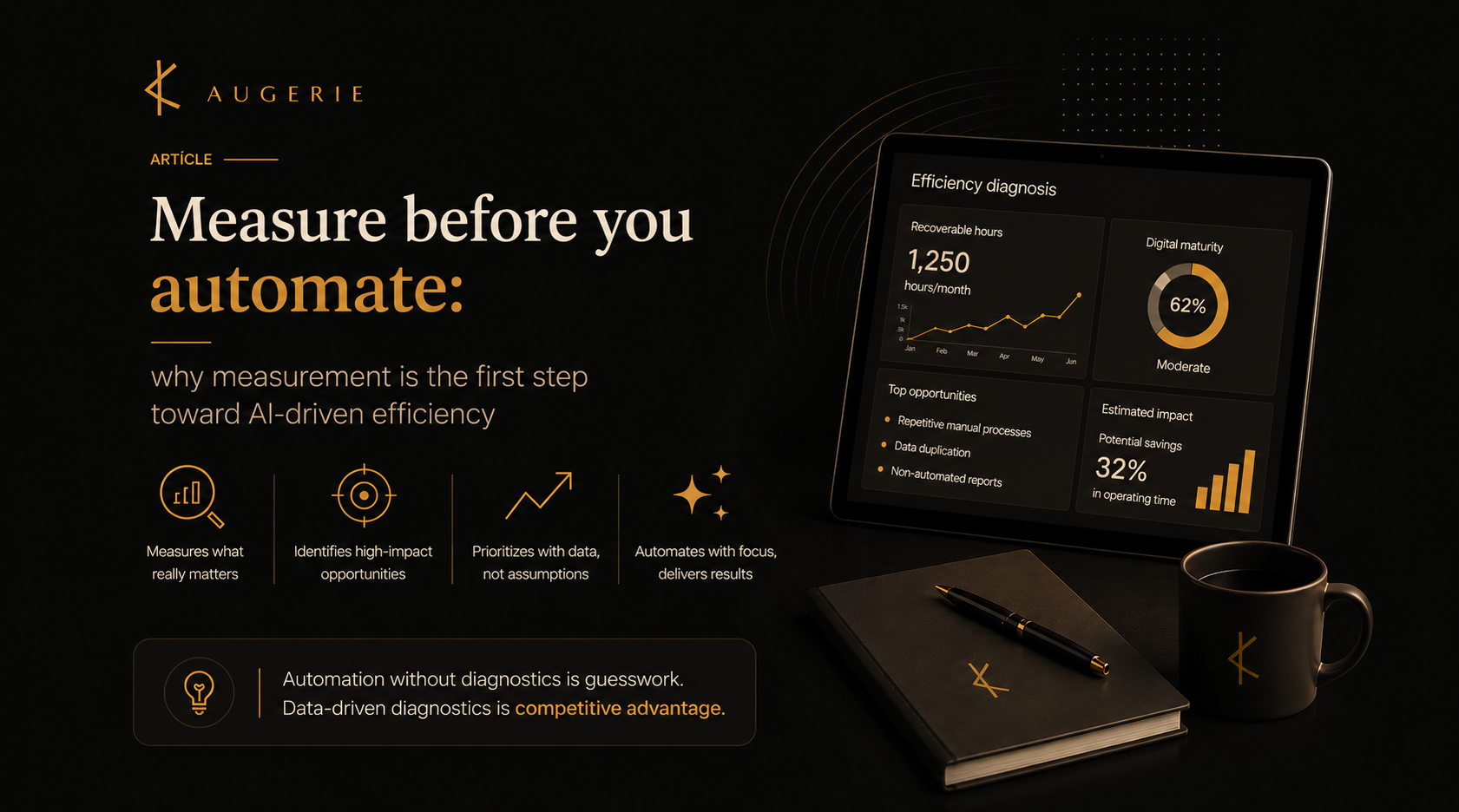
That is why at Augerie we never start an automation conversation with a proposal. We start with an AI efficiency diagnosis: a brief questionnaire about how the business currently operates—customer support, sales follow-up, marketing, reporting, data security, and web presence—that delivers a customized report outlining recoverable hours per week, money at risk due to lack of follow-up, and the level of risk in handling customer data. No industry averages, no generic packages—the recommended solutions are strictly those that the diagnosis shows apply to that specific business, with scope and pricing clearly defined from the very first report.
Automating without measuring first is gambling. Measuring first is what separates automation that truly recovers time and money from one that merely looks good in a demo.
Want to see what the diagnosis would find in your business? [Schedule a meeting to learn about the process →]
References
Oldroyd, J. B. (2007). Lead response management study. MIT Sloan School of Management / InsideSales.com.
Oldroyd, J. B., McElheran, K., & Elkington, D. (2011, March). The short life of online sales leads. Harvard Business Review, 89(3), 28–30.
Tinkoff, D., Van der Veken, L., & Chui, M. (2026). The state of AI in 2026. McKinsey & Company. https://www.mckinsey.com/capabilities/quantumblack/our-insights/the-state-of-ai
Verizon. (2019). Data breach investigations report. Verizon Business.